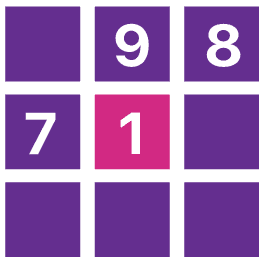
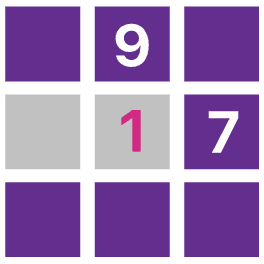
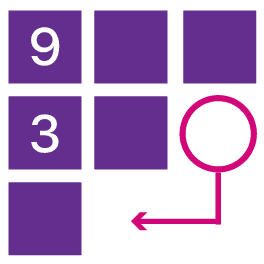
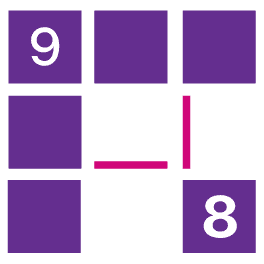
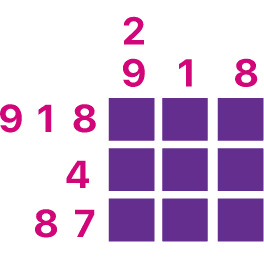
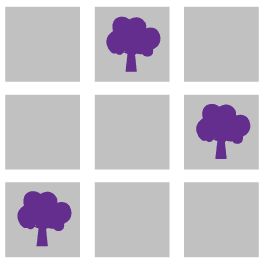
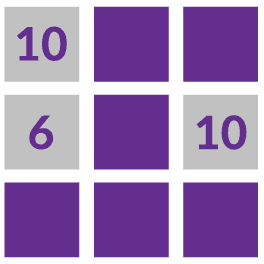
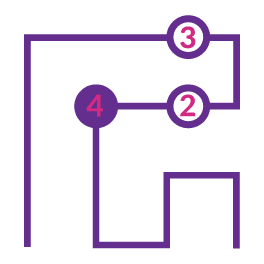
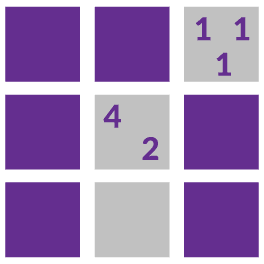
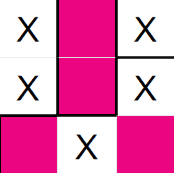
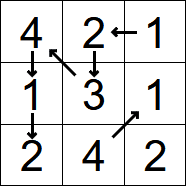
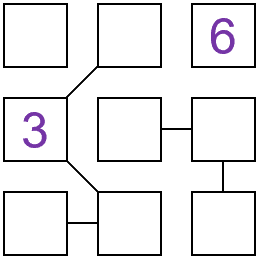
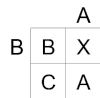
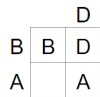
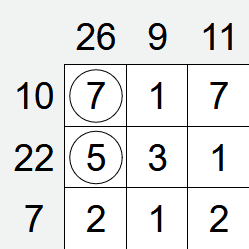
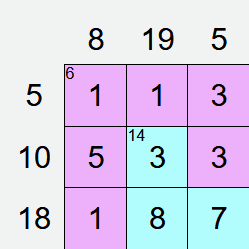
The aim of a Yajilin puzzle is to draw a single closed loop passing through every non-filled and non-clue cell.
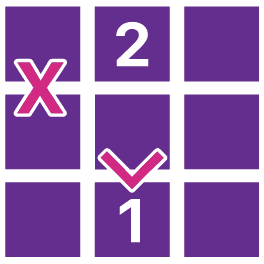
The clues tell you exactly how many filled cells are in the given direction.
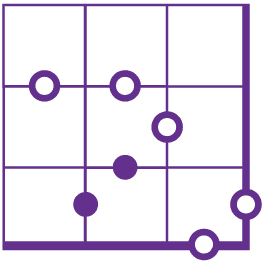
Filled cells cannot touch each other (diagonally is fine).
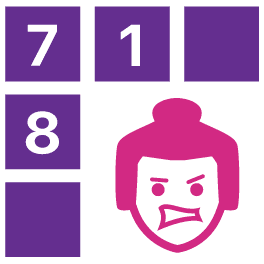
There can be no empty cells - each cell must be a clue, filled, or contain the loop.
This is an example of a starting Yajilin grid. A starting grid only has clues, and we can see that
some of the clues are already satisfied, i.e. we don't need to insert any more filled cells in some of
those rows and columns.
For those clues that are satisfied, we can insert a dot (to denote a cell containing a path, but we
don't know the exit directions) in all the cells in the row/column from that clue.
We've inserted dots in the rows and columns affected by the 0 clues - we know these cells will contain
the path, but we don't know the exit directions yet.
We know cell 'A' will contain the path, but this cell only has two possible exit directions - to the right
and downwards.
We can say the same thing about cell 'B' - there are only two possible exit directions, right and upwards.
We can also fill cell 'C' - it's the only possible option for the '1' clue to its immediate left.
We know that filled cells cannot touch other (diagonally is fine), this means that cell 'A' must contain
the path, we shall insert a dot in this cell.
Cells 'B' and 'C' are at dead-ends - if the path enters either of these cells, it's not going to be able
to come back out, so both of these must be filled cells.
There is a group of cells starting at cell 'D' and passing through cells 'E', 'F', 'G', 'H', 'I'. If any
of these cells were filled, that would create a dead-end. This would break the rules of Yajilin, so the
path must pass through cell 'D' and continue through cells 'E', 'F', 'G', 'H', to reach cell 'I'.
The '1 down' clue is now satisfied, so cell 'A' must contain the path.
Cell 'B' is next to a filled cell, this means it must contain the path.
If cell 'C' was filled, then it would leave a dead-end in cell 'D', this means that cell 'C' must contain
the path.
We can apply the same reasoning to cells 'E' (dead-end above), 'F' (dead-end below), 'G' (dead-end to
the right).
We can apply the same reasoning from the previous step to conclude that the path passes around the
'1 down' clue in the top-left.
Part of solving a Yajilin puzzle is looking at the cells you know the path must pass through, and looking
to see if there is only one possible solution.
This is what we will do now. We know the path must pass through cells 'A', 'B' and 'C', there is only
one possible route here (remember that multiple closed paths are not possible).
The same is true for cells 'D', 'E', 'F', 'G' and 'H'.
We shall now look at the "1 down" clue in the middle of the grid - the only available cells in this column
to satisfy this clue are cells 'A' and 'B'.
If we filled cell 'B', this would mean that the path would have to pass through cell 'C', but this gives
us an impossible situation with this clue. This means that cell 'A' must be filled.
We also have a "1 up" clue in the bottom-right that we have to satisfy, cell 'D' is the only available
cell left in this column, so this cell must also be filled.
With a couple of obvious steps we arrive at this position. You have now seen all the techniques required
to solve Yajilin puzzles.


 Yajilin leaderboard
 How to play