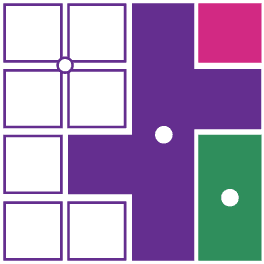
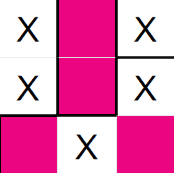
This is an example of a completed LITS puzzle. The grid is split up in to regions with at least 4 cells
each, your aim is to insert a Tetromino in each region such that,
Two Tetrominoes of the same type can't touch horizontally or vertically. Additionally,
this applies to rotations and reflections as well.
The Tetrominoes should form one continuous area.
2×2 filled cells are not allowed.
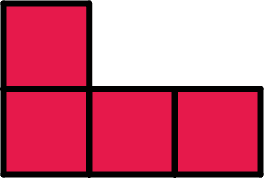
Tetrominoes are the possible shapes made of 4 connecting cells. There are 5 Tetromino shapes in total: L, I, T, S, and O, but
rule 3 means we can't use the 'O' Tetromino. This is where the name of the puzzle comes from.
This is an example of a starting LITS puzzle. You will sometime find that a starting puzzle has some
regions are exactly 4 cells, i.e. you can just fill those regions in straight away.
That isn't the case here. A good starting technique in this kind of situation is to look at regions
that are only 5 or 6 cells. There are 3 regions in this starting grid that only have 5 cells. For each
of these 3 regions, there are only 2 different ways we can insert a Tetromino, so we can fill in the
overlapping cells.
We are now in this situation, and can make a few observations,
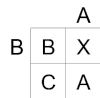
We can't fill in cell A as this would break rule 3, i.e. we can't have any filled 2×2
blocks. This means cell A must be empty.
This only leaves one option of Tetromino for this region, i.e. cell B must be filled.
Apply rule 3, we can also conclude that cells C and D must be empty.
We are now in this situation, and can make a few observations,
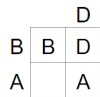
If we filled in cell A, this would leave us with two S Tetrominoes next to each together,
which breaks rule 1.
This means cell B must be filled.
With the 'X' we inserted last time, the region on the left only has 5 available cells, and we
can fill in cells C, D and E.
Some more observations,
Cell A must be empty to make sure we don't break rule 3.
Filling in cell B would give us two S shaped Tetrominoes together and break rule 1, so cell B
must be empty.
This means cell C must be filled.
We can also insert a I Tetromino across the top as we only have 4 unfilled cells in this region now.
More observations,
Filling in cell A would give us 2 Tetrominoes of the same type next to each other, so cell A
must be empty.
This means cell B must be filled.
Our final observations for this puzzle,
Cell A must be filled to satisfy rule 2, i.e. all filled cells must form one continuous whole.
This region can't contain a S or L Tetromino as after filling cell A it will be touching both of
these types.
There is no way to insert a T Tetromino in this region without breaking rule 3.
This means this region must contain a I Tetromino, and there is only one way to do this.
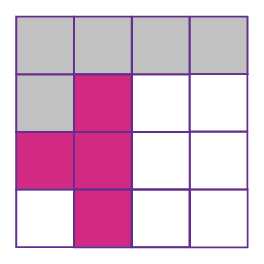

 Lits leaderboard
 How to play